
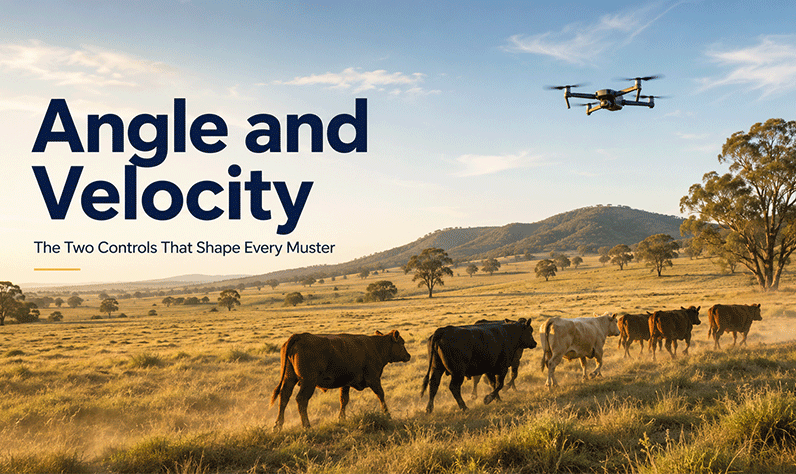
Most drone operators focus on where they need the animals to go. The ones who really understand aerial stockmanship focus on something more fundamental: how the drone is moving, and what that movement is communicating to the animal below.
Two variables control everything about how pressure lands on an animal from the air: the angle of your approach, and the velocity at which you move. Get both right, and you can guide a mob with precision and calm. Get either one wrong, and no amount of persistence will fix it.
Livestock will always tell you how you're doing. If they're moving where you want, your angle and velocity are right. If they're not, adjust one or both — before you even think about increasing overall pressure. |
Why These Two Variables Matter So Much
On the ground, a stockperson communicates with animals through a whole range of subtle signals — slowing their walk, adjusting posture, reading an ear or an eye. From the air, almost all of that disappears. The drone has no body language. What the animal reads is position and energy, and nothing else.
That makes aerial stockmanship both cleaner and less forgiving. The signals are simpler, but there's no nuance to fall back on if you've read the situation wrong. Angle tells the animal where to go. Velocity tells it how urgently to get there. Together, they're the entire vocabulary of aerial pressure.
There's also something most operators don't realise until they've seen it: a mob's sensitivity increases once it starts moving. Animals that are stationary will let you get surprisingly close before they respond. The same animals in motion will react to the drone at a much greater distance. This is one of the most important things to understand about working mobs from the air — and it changes how you think about both variables entirely.
The Angle Problem
New operators often assume that the most direct approach gets the fastest response. It does — but not always the response they want.
The angle you choose doesn't just determine how much pressure you're applying. It determines where the animals go. Approach from the wrong angle and the mob splits, scatters sideways, or turns back toward you. Approach from the right angle and the mob moves forward together, leaders first, in the direction you want.
There's also an instinctive response in animals to curved, sweeping approaches that most operators don't account for — something that mimics a predator's behaviour and triggers a very different reaction to a straight-line approach. Understanding this, and knowing how to use straight lines and sharp directional changes instead of arcs, is one of the most immediately practical things an aerial stockperson can learn.
The first question when a mob isn't responding isn't "am I close enough?" It's "is my angle right?" In most cases, adjusting position produces a cleaner response than getting closer from the wrong angle. |
The Velocity Problem
Velocity is the variable most operators reach for when things aren't working: speed up, close the gap, increase the energy. Sometimes that's right. More often, it compounds the problem.
Think of it like a tap. Angle is the direction you're pointing the hose. Velocity is how far open the tap is. A high-pressure blast from a perfect angle still creates chaos if the mob isn't ready for it. A gentle trickle from exactly the right position can be enough to get a mob moving calmly and keep it moving.
The relationship between velocity and the flight zone is also counterintuitive. A fast approach shrinks the distance at which animals react — they respond at a much greater range to a fast-moving drone than a slow one at the same angle. Understanding how velocity and flight zone interact, and how to use slower speeds to build trust and faster ones only when the situation calls for it, is what gives operators real precision.
Reading the Response
The good news is that animals give constant, honest feedback. A mob moving forward together with neutral head carriage and relaxed movement is telling you your angle and velocity are right. A mob that stalls, splits, turns back, or mills without direction is telling you something's off — and that something is almost always position or speed, not stubbornness.
Learning to read those signals accurately, and to make the right adjustment quickly, is the core skill in aerial stockmanship. Not more pressure. The right pressure. And knowing the difference between a mob that needs a change of angle, a change of speed, or simply a moment to settle before you re-engage.
"If they're doing what you want, you're not in the wrong place." — Bud Williams |
What This Looks Like in Practice
The operators who handle mobs most effectively from the air don't look like they're doing very much. Slow, deliberate movement. Long pauses. Mobs that seem to choose their own direction. That isn't effortlessness — it's precision. It's the result of understanding exactly what angle and velocity to use at every stage of a muster: gathering, forming the mob, driving, settling, and restarting.
Each of those phases has different demands. The approach that works for gathering scattered animals isn't the same approach you'd use to drive a formed mob. The velocity that gets reluctant animals moving in the morning isn't the one you want once they're moving well. Knowing how to modulate both controls across the full arc of a muster is what separates operators who get results from operators who consistently get great results.
The Deeper Skill Set
Angle and velocity are the two controls. But using them well requires understanding the animal psychology underneath them — why animals respond the way they do to different positions and speeds, what it means when a mob's sensitivity changes, how to read individual animals within a group, and how every choice you make today shapes how that mob responds next time.
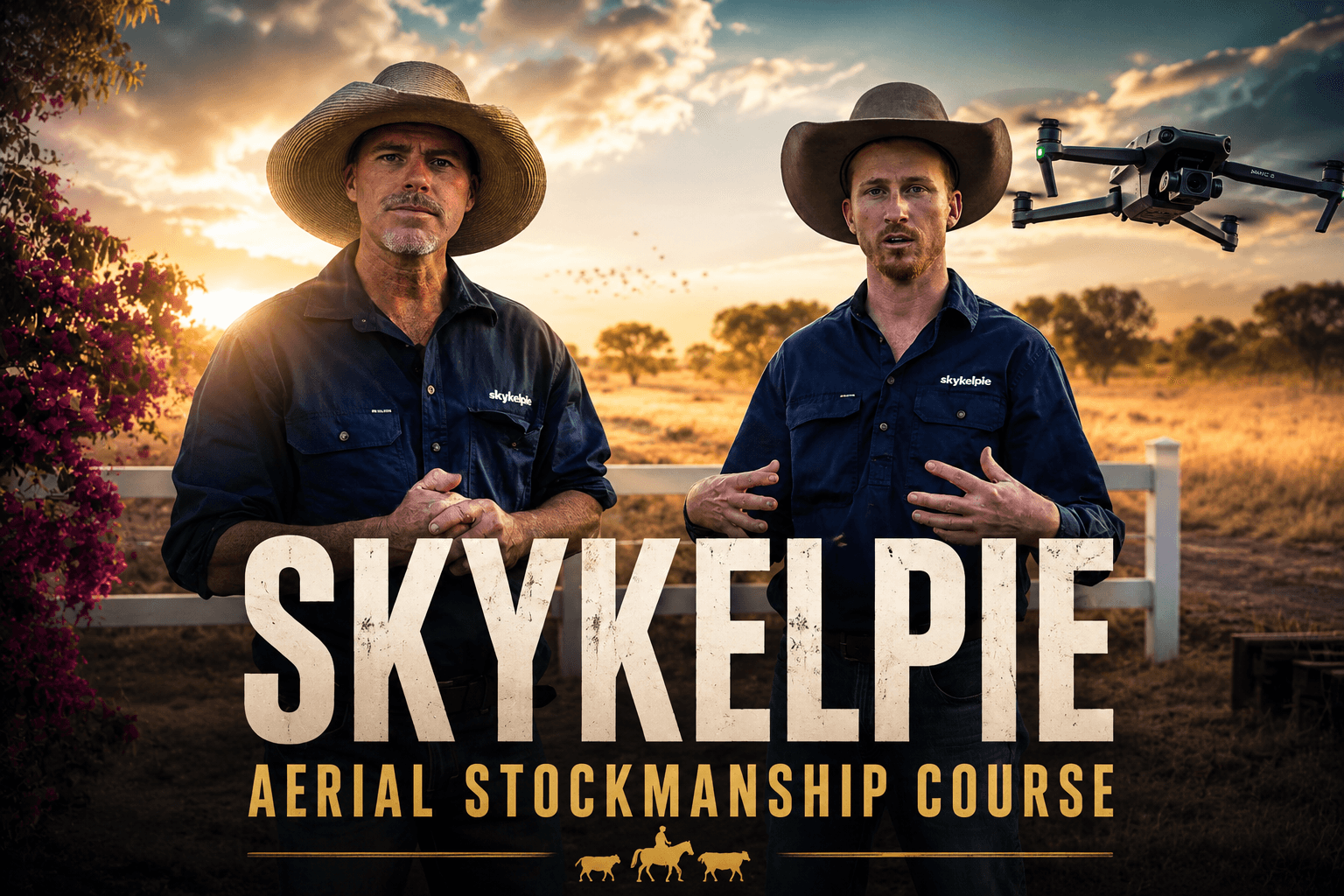
The SkyKelpie Aerial Stockmanship Masterclass goes deep on all of it: the science of flight zones and pressure, the practical techniques for each phase of a muster, and the decision-making frameworks that let operators read any situation and respond correctly. It's the difference between knowing the two variables exist and actually knowing how to use them.
Ready to develop real precision in the air? Enrol in the SkyKelpie Aerial Stockmanship Masterclass at skykelpie.com/course |
Featured in this guide
Was this article helpful?
Your feedback helps us improve our documentation