
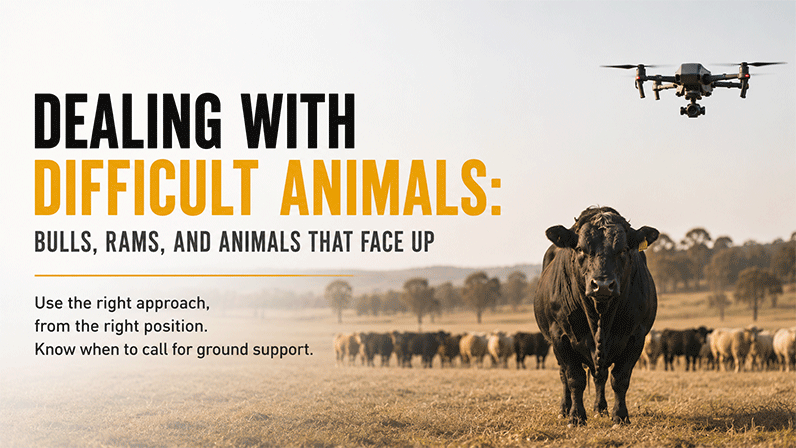
Every muster has at least one. The bull that plants his feet and stares down the aircraft. The ram that turns to face instead of moving away. The assertive individual who simply refuses to follow the mob.
Working these animals incorrectly doesn't just slow the job down — it actively trains them to be harder next time. Here's what's really going on, and why the instinct to apply more pressure is almost always wrong.
"With difficult animals, the temptation is always to apply more pressure. Almost always, the answer is less, applied from a better position." |
Why They're Different
Most livestock are prey animals. When they sense a threat entering their flight zone, their instinct is to move away from it. That's the reflex aerial stockmanship works with.
Dominant males — and some individuals with particularly assertive temperaments — don't always follow this pattern. For these animals, the response to perceived threat isn't flight. It's assessment. They turn to face it, plant their feet, and hold their ground. This isn't stubbornness. It's hardwired into the role they play in the herd hierarchy.
The result is an animal that, when pressured incorrectly, doesn't just fail to move — it becomes more entrenched. Every unsuccessful attempt reinforces the idea that the aircraft can be beaten.
The Mistake Most Operators Make
Approaching dominant animals from directly behind is the most common error. For the general mob, rear pressure works — it drives animals forward and works with the herd instinct. For bulls, rams, and assertive individuals, it does the opposite.
Pressure from behind is exactly what causes these animals to turn and face the drone. And once they've turned, you've already lost the positional advantage. The animal is now in its most confident posture — facing the threat, feet planted, ready to hold its ground.
Continuing to pressure a confrontational animal from the front makes the situation significantly worse, not better.
Applying pressure from the wrong position on a dominant animal doesn't create movement. It creates a standoff — and every standoff that animal wins makes the next muster harder. |
Reading the Situation — and Knowing When to Hand It Over
There are situations the aircraft simply can't resolve, and experienced aerial stockpeople know the signs. An animal that charges toward the drone, escalates its confrontational posture despite correct technique, or has faced up across multiple attempts — that's the signal to disengage.
Pulling the aircraft back entirely and calling for ground support isn't a failure. A person on foot, a motorbike, a horse, or a dog operates on a completely different psychological channel to an aerial aircraft. Ground pressure can often break a standoff that the drone cannot.
The bull that successfully faces up an aircraft today is a harder problem next muster. The professional decision is to get it handled properly — not to keep pushing until something goes wrong.
"Knowing when to back off is not failure. It's the mark of a stockman who understands animals well enough to know that the right tool for this moment isn't in the air." |
There's a Right Way to Handle These Animals
Knowing what not to do is step one. The technique for approaching, repositioning, and re-engaging assertive animals — in a way that creates movement without escalating confrontation — is something that can be learned and practised.
It comes down to understanding flight zones, positional pressure, how to give an animal somewhere to go before asking it to move, and how to release pressure at exactly the right moment. When done correctly, even assertive animals become manageable from the air over time. When done incorrectly, the problem compounds with every muster.
The SkyKelpie Aerial Stockmanship Masterclass covers exactly this: the principles behind why difficult animals behave the way they do, the techniques for handling them correctly, and the judgement to know when to call in ground support before the situation escalates.
Ready to develop real precision in the air? Enrol in the SkyKelpie Aerial Stockmanship Masterclass at skykelpie.com/course
Featured in this guide
Was this article helpful?
Your feedback helps us improve our documentation