
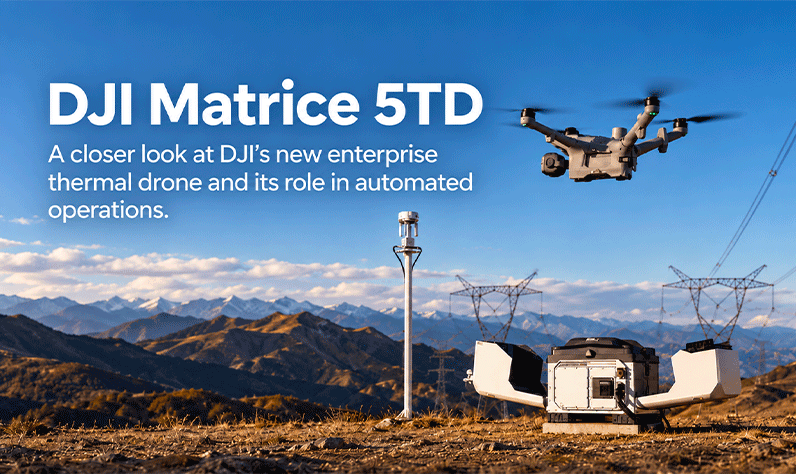
Launched alongside the new DJI Dock 4, the Matrice 5TD has been designed to support demanding remote and automated drone operations.
With up to 59 minutes of flight time, a 1280 × 1024 thermal camera, integrated LiDAR and radar, and AI-assisted object detection, the aircraft represents a substantial advancement in DJI's automated drone technology.
For Australian industries such as agriculture, security, mining, energy, and infrastructure, these capabilities could enable more effective aerial monitoring and inspection operations.
Looking for the Matrice 5T? The Matrice 5TD is DJI’s dock drone. DJI reveals its next foldable thermal drone, tipped to be the Matrice 5T, on 5 November. See what we know about the DJI Matrice 5T.
What is the DJI Matrice 5TD?
The DJI Matrice 5TD is an enterprise-grade, multi-sensor drone developed for use with the DJI Dock 4 automated docking system.
Unlike a conventional drone that requires an operator to be physically present for every launch and battery change, the Matrice 5TD is designed to operate as part of a remotely managed system.
This means businesses can position a Dock 4 at a suitable location and conduct scheduled or remotely initiated flights, subject to regulatory approvals and operational requirements.
The aircraft integrates visual cameras, thermal imaging, laser rangefinding, and advanced environmental sensing.
Rather than specialising in just one type of inspection, the Matrice 5TD offers a versatile aerial platform for organisations requiring several types of data from the same mission.
DJI Matrice 5TD: Key Specifications
Feature | Specification |
|---|---|
Maximum flight time | 59 minutes |
Maximum hovering time | 55 minutes |
Maximum operating radius | 10 km |
Maximum flight speed | 21 m/s (specific FlyTo tasks) |
Thermal camera | 1280 × 1024 resolution |
Wide-angle camera | 50 MP, 1/0.98-inch CMOS |
Medium tele camera | 50 MP, 1/1.28-inch CMOS |
Tele camera | 50 MP, 1/1.5-inch CMOS |
Laser rangefinder | Up to 3,000 m under specified conditions |
Obstacle sensing | Vision, LiDAR, mmWave radar and infrared |
AI detection | 17 object types |
Weather resistance | IP55 |
Operating temperature | -40°C to 50°C |
Aircraft weight | Approximately 2.6 kg |
Dock compatibility | DJI Dock 4 |
Figures are based on DJI's published specifications. Maximum performance values are achieved under particular test conditions, and operational results may vary.
High-Resolution Thermal Imaging: 1280 × 1024
One of the most significant features of the DJI Matrice 5TD is its upgraded thermal imaging system.
The aircraft incorporates a thermal camera with a native resolution of 1280 × 1024 pixels, allowing operators to observe temperature differences with greater image detail.
Thermal cameras detect infrared radiation rather than relying on visible light, making them useful for a wide range of specialised applications.
What can the thermal camera be used for?
Livestock monitoring: Thermal imaging may assist with locating animals, particularly in low-light conditions or where temperature contrast makes livestock easier to distinguish from their surroundings.
Solar farm inspections: Thermal imagery can help identify unusual heat signatures across solar panels and electrical infrastructure, supporting targeted maintenance investigations.
Search and rescue: Thermal imaging can assist teams searching for people in suitable environmental conditions, particularly at night.
Security: Thermal cameras can provide useful situational awareness in low-light environments where conventional cameras may be less effective.
Industrial inspections: Temperature anomalies may help operators identify potential issues involving equipment, electrical assets, or infrastructure.
The Matrice 5TD also supports temperature measurement, visible-thermal image fusion, and multiple thermal display palettes.
Its thermal measurement ranges extend from -40°C to 150°C in high-gain mode and 0°C to 550°C in low-gain mode.
Importantly, thermal imagery does not allow operators to see through solid objects or dense vegetation. Environmental conditions, surface characteristics, and target temperature differences all influence what can be detected.
Three 50 MP Cameras for Detailed Aerial Inspections
In addition to its thermal camera, the Matrice 5TD incorporates three visual cameras, providing different fields of view for observation and inspection.
Wide-Angle Camera
The wide-angle camera features a 50 MP, 1/0.98-inch CMOS sensor with a 23.5 mm equivalent focal length.
This camera is well suited to capturing broad scenes, providing general situational awareness, and documenting larger areas.
For rural operators, it could be used to assess paddocks, infrastructure, and the surrounding landscape.
Medium Tele Camera
The medium tele camera uses a 50 MP, 1/1.28-inch CMOS sensor with a 70 mm equivalent focal length.
This provides a narrower field of view than the wide-angle camera, enabling closer observation of specific objects without immediately repositioning the drone.
Potential applications include inspecting buildings, checking equipment, and observing infrastructure from a distance.
Telephoto Camera
The telephoto camera features a 50 MP, 1/1.5-inch CMOS sensor and a 252 mm equivalent focal length.
This provides approximately 11× optical magnification relative to the wide-angle camera's focal length, allowing operators to examine more distant subjects.
For security, utility inspections, and agricultural monitoring, the ability to inspect an object from a safer or more practical distance can be valuable.
The Matrice 5TD also supports 4K video recording, making it suitable for detailed visual documentation.
Advanced Obstacle Detection with LiDAR and mmWave Radar
Operating drones remotely introduces important challenges, particularly when flying around buildings, vegetation, powerlines, and other obstacles.
The Matrice 5TD incorporates a multi-layered sensing system designed to improve environmental awareness.
This includes:
Omnidirectional binocular vision sensing.
A rotating LiDAR sensor.
Forward, upward, and downward millimetre-wave radar.
A downward-facing infrared ranging sensor.
LiDAR uses laser-based measurements to detect surrounding objects and provide distance information.
Millimetre-wave radar complements other sensing systems and can assist with detecting particular obstacles under supported conditions.
For operations around industrial infrastructure or rural assets, these sensing capabilities may improve the drone's ability to navigate complex environments.
However, obstacle sensing has operating limits and does not guarantee detection or avoidance of every hazard. Powerlines, thin wires, weather, and other environmental conditions still require careful consideration.
AI-Powered Detection of 17 Object Types
Another major advancement is the inclusion of onboard AI-assisted object detection.
DJI states that the Matrice 5TD can identify 17 object types, supporting more intelligent observation and operational workflows.
This is particularly relevant for businesses that want to use drones for monitoring rather than simply recording video.
For example, compatible AI functionality could support security operations by helping identify relevant objects or activity for an operator to review.
In infrastructure environments, AI-assisted detection may help teams organise and interpret information gathered during inspections.
For agriculture, the technology highlights the potential for more advanced livestock and asset-monitoring applications.
It is important to distinguish between detecting a supported object category and independently making a reliable operational decision. Detection accuracy depends on the environment and supported software capabilities.
At SkyKelpie, we see significant long-term opportunities for AI-assisted drone operations, particularly as aircraft sensors and autonomous systems continue to improve.
Up to 59 Minutes of Flight Time
Flight endurance remains one of the most important considerations when selecting an enterprise drone.
DJI rates the Matrice 5TD for a maximum flight time of 59 minutes, with a maximum hovering time of 55 minutes.
These figures represent ideal test conditions, and real-world endurance will vary depending on wind, temperature, flight speed, payload, and battery management.
For applications involving large properties, industrial facilities, or repeated inspection routes, improved flight endurance creates opportunities to cover more ground during a single mission.
DJI also specifies a maximum operating radius of 10 km under defined test conditions.
When combined with the DJI Dock 4's automated battery swapping, the aircraft can support repeatable missions with relatively short turnaround times.
This is especially valuable for operations requiring frequent aerial coverage rather than occasional flights.
Built for Challenging Environments
Australian enterprise drones frequently operate in difficult conditions.
From remote cattle stations and mine sites to coastal infrastructure and industrial facilities, equipment must contend with heat, dust, moisture, and changing weather.
The Matrice 5TD carries an IP55 ingress protection rating and an operating temperature specification of -40°C to 50°C.
It also features integrated RTK positioning capabilities and a maximum specified wind resistance of 12 m/s.
These capabilities help make it suitable for demanding outdoor operations, although the published ratings should not be interpreted as permission to fly in all weather conditions.
Operators must still consider site conditions, local regulations, and manufacturer operating guidance.
DJI Matrice 5TD vs Matrice 4TD: What's Changed?
For organisations familiar with the DJI Matrice 4TD, the new Matrice 5TD introduces several notable improvements.
According to DJI, the upgrades include:
Longer flight endurance: The Matrice 5TD offers a maximum flight time of up to 59 minutes.
Higher-resolution thermal imaging: A new 1280 × 1024 thermal camera provides greater native image resolution.
Improved telephoto capability: The upgraded telephoto camera offers approximately 11× optical magnification relative to the wide camera.
Additional sensing technologies: Integrated LiDAR and millimetre-wave radar expand the aircraft's environmental sensing capabilities.
Enhanced communications: Updated video transmission capabilities include additional supported frequency bands and integrated dual 4G modules, although availability varies by region.
AI object detection: Onboard AI supports detection across 17 object types.
Additional accessory options: The aircraft provides mounting positions for supported accessories, allowing further customisation.
These improvements are particularly meaningful when considering continuous, remote, or more demanding automated drone operations.
The most appropriate system will still depend on the application, required features, and overall investment.
How Could the Matrice 5TD Benefit Australian Agriculture?
For Australian graziers, technology is most valuable when it solves practical problems.
Large distances, dispersed livestock, labour requirements, and extensive infrastructure all create opportunities for aerial monitoring.
At SkyKelpie, we've seen how enterprise drones can improve access to information and make agricultural operations more efficient.
The Matrice 5TD offers several potential applications.
Livestock Location and Monitoring
Thermal and zoom cameras could assist with locating and observing livestock at selected sites.
For example, a drone may be used to inspect livestock around watering points or holding paddocks without requiring an employee to travel to the site.
Monitoring Remote Infrastructure
Scheduled aerial inspections could help property managers observe water infrastructure, sheds, roads, and other assets.
This may allow teams to identify visible issues earlier and make better-informed maintenance decisions.
Property Security
The Matrice 5TD's thermal imaging, zoom capabilities, and compatibility with Dock 4 make it a potentially useful tool for monitoring high-value assets.
Future Autonomous Agricultural Applications
The integration of AI, thermal imaging, and environmental sensing creates opportunities for increasingly sophisticated agricultural drone systems.
However, the Matrice 5TD should not be confused with a fully autonomous livestock-mustering solution.
Effective drone mustering requires suitable aircraft control, animal behaviour knowledge, aerial stockmanship, and appropriate operational procedures.
We see automated monitoring and active livestock mustering as complementary applications, each with different technical and operational requirements.
Is the DJI Matrice 5TD Suitable for Security and Infrastructure?
Absolutely worth considering, particularly where organisations need regular aerial awareness across large or sensitive sites.
For security providers, the aircraft's thermal and zoom cameras could assist with monitoring buildings, industrial estates, and perimeter areas.
Solar farm operators may benefit from repeatable visual and thermal inspections.
Mining and infrastructure businesses could use its imaging and sensing technology to support remote asset inspections and situational awareness.
Its integration with DJI Dock 4 is especially important for organisations looking to establish a more permanent aerial monitoring capability.
Rather than sending a drone team to every location, appropriately approved operations can be managed from a central location.
What Should Australian Buyers Consider?
Before purchasing or deploying a Matrice 5TD system, businesses should assess several factors.
These include the intended application, expected return on investment, communications coverage, site infrastructure, ongoing maintenance, and aviation regulatory requirements.
For remotely operated or BVLOS applications, CASA approvals and operational authorisations may be required.
It is also worth understanding whether a permanent docking solution is genuinely necessary.
For some businesses, a conventional handheld-controller enterprise drone may provide better value.
For others, especially those conducting regular inspections or requiring rapid aerial responses, the investment in automated infrastructure may be justified.
Explore the DJI Matrice 5TD with SkyKelpie
The DJI Matrice 5TD represents an important advancement in enterprise drone capabilities.
Its combination of high-resolution thermal imaging, three 50 MP visual cameras, advanced sensing technology, AI-assisted detection, and extended flight endurance makes it a compelling aircraft for a wide range of professional applications.
When paired with DJI Dock 4, it provides a foundation for more advanced automated aerial operations.
SkyKelpie works with Australian businesses to identify practical drone solutions, from agriculture and aerial stockmanship to remote monitoring and enterprise applications.
We understand that the right solution depends on more than specifications alone.
Interested in DJI Matrice 5TD or DJI Dock 4? Contact the SkyKelpie team to discuss how this technology could support your operations.
Was this article helpful?
Your feedback helps us improve our documentation