
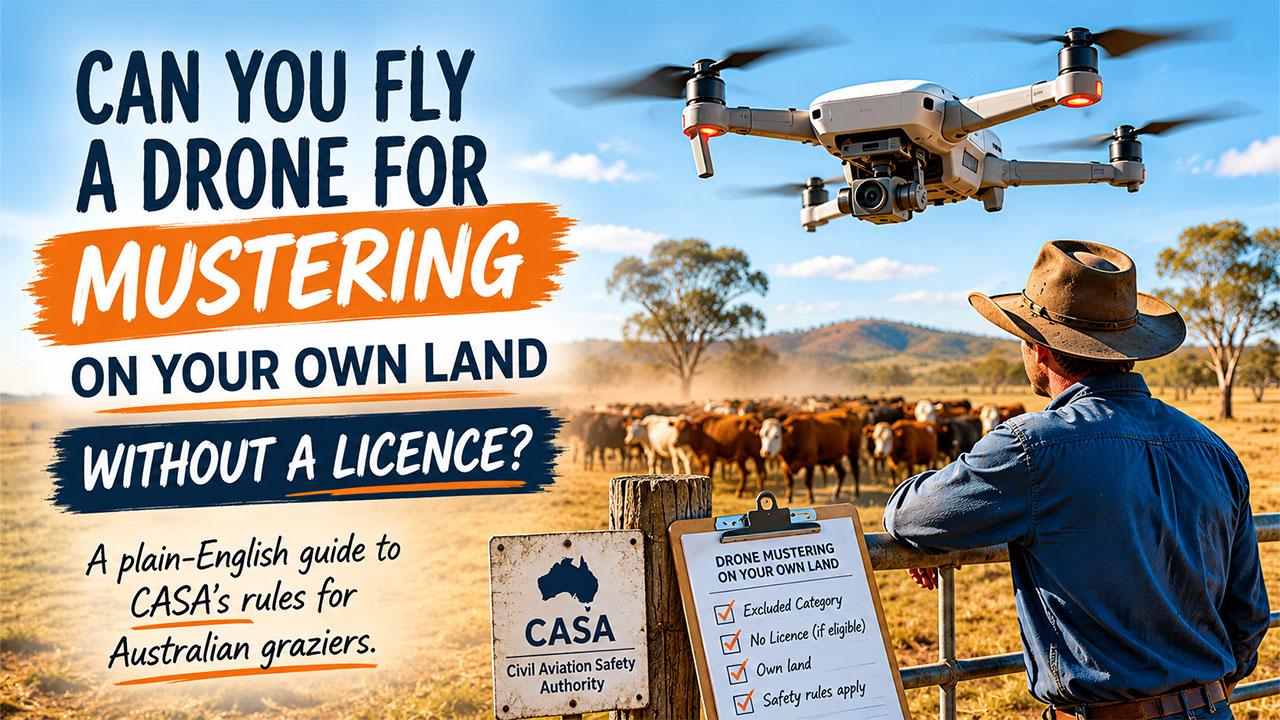
Short answer: in many cases a landholder can fly a drone for mustering on their own property without holding a remote pilot licence — but it depends on the drone’s weight, how and where you fly, and whether the work is strictly for your own farming business. If you fly commercially for others, or outside the standard operating conditions, you generally need formal accreditation. Always confirm the current rules with CASA before you fly.
This guide answers the licence question specifically for mustering. For the complete landholder rules — which drones qualify, registration and accreditation, and how to stay compliant — see our full guide: CASA Landholder Rule: fly drones on your farm without a licence.
The licence question, in farmer terms
Australia’s drone rules are set by the Civil Aviation Safety Authority (CASA). For many graziers, operating under the ‘excluded category’ provides a practical lower-risk pathway, allowing certain drone activities to be conducted without the need for the full Remote Pilot Licence (RePL) and Remote Operator’s Certificate (ReOC) typically required for commercial operations.
Flying on your own land
CASA has long-standing provisions that let landholders use drones for jobs connected to their own primary-production business — like checking stock, fences and water, and mustering — without a remote pilot licence, provided you stay within the standard operating conditions. Broadly, those conditions mean:
keep the drone within visual line of sight (you can see it with your own eyes, not just on a screen);
fly in daylight and below the standard height limit of 120 metres;
keep well clear of people, livestock handlers, aircraft and aerodromes;
don’t fly over towns or public gatherings;
you must not be paid by someone else for the flying — it’s for your own operation or you are an employee of the landholder.
Confirm the exact current conditions and height limits on casa.gov.au — they can change.
Does the drone’s weight matter?
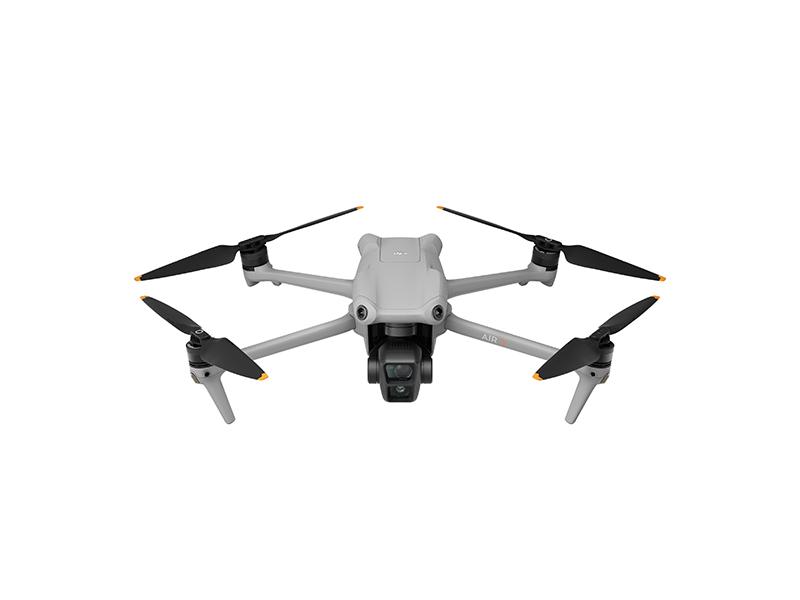
Yes. Drone weight still matters, but for most graziers the key practical threshold is whether the aircraft is 25 kg or less. Under CASA’s private landholder excluded category, a typical mustering drone up to 25 kg can generally be flown over your own paddocks without a Remote Pilot Licence (RePL) or Remote Operator’s Certificate (ReOC), provided the operation stays within the standard operating conditions, the drone is registered, the operator holds the required accreditation, records are kept, and the flying is for your own property work rather than paid work for someone else. If the aircraft is over 25 kg, it may still be possible to fly over your own land, but additional requirements apply, including holding a RePL for that type and model of aircraft.
When you DO need formal accreditation
You’re flying for someone else (contract mustering, paid work);
You want to fly beyond the standard operating conditions (beyond line of sight, at night, higher than 120 metres);
Your operation falls outside the excluded category.
In those cases you’re generally looking at a remote pilot licence (RePL) and operating under an operator’s certificate (ReOC).
Get confident and compliant
Knowing you’re allowed to fly is only step one — mustering well is a skill. Our course covers how to actually move stock calmly and effectively with a drone, alongside safe, sensible operation.
This article is general information, not legal advice. Rules change — confirm current CASA requirements at casa.gov.au before flying. Information published 24 May 2026.
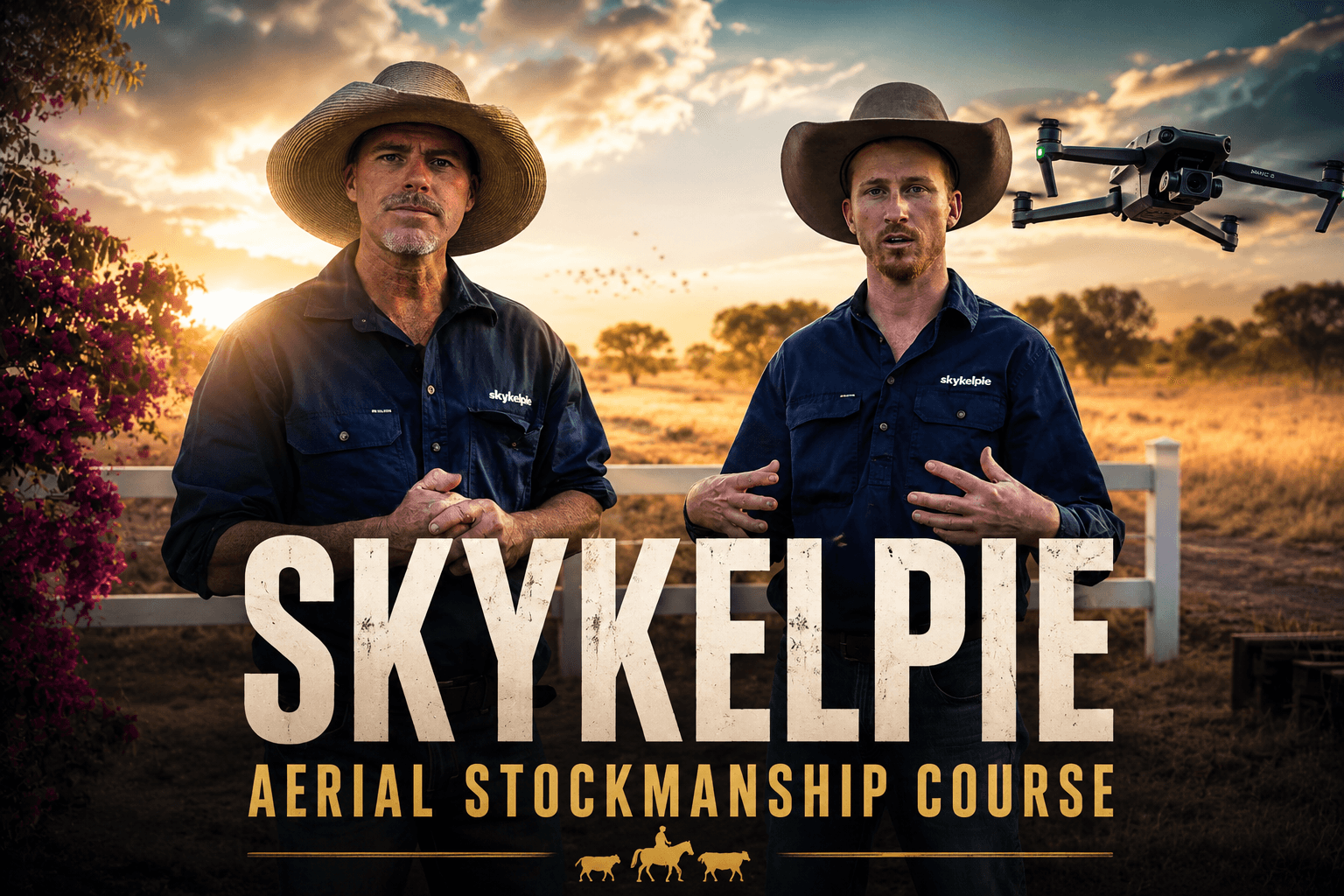
Ready to learn to muster with a drone properly? The SkyKelpie Aerial Stockmanship Course walks you through it from setup to yard work — filmed on real working properties.
Featured in this guide
Was this article helpful?
Your feedback helps us improve our documentation