
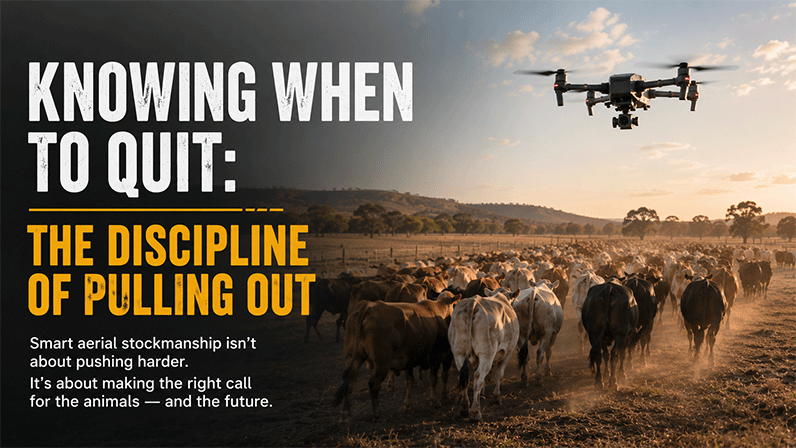
There's a particular temptation when you're in the air. You can see everything. You can see exactly where the mob needs to go, exactly what's going wrong, and it feels like with just a bit more effort, you could fix it.
Sometimes that's true. But experienced aerial stockmen know that persisting with pressure in the wrong situation doesn't produce better results — it produces animals that are harder to handle today, and harder still next muster.
Knowing when to pull out isn't a gap in your skill set. It is a skill set.
"The aircraft is a tool. Like any tool, it has limits. Knowing those limits is not a weakness — it is expertise." |
The Physics Problem Nobody Talks About
Here's a scenario that catches operators off guard: a large mob is moving forward, you need the lead animals to stop, your positioning is correct, your technique is right — and they walk straight through you anyway.
It's not a failure of skill. It's physics.
When there are hundreds of tonnes of cattle behind the lead animals, those leaders physically cannot stop. The mob behind them is driving them forward. Momentum, gravity, and mob psychology are all working in the same direction. Placing an aircraft in front of them at that moment isn't stockmanship — it's a lesson being taught that aerial pressure can be ignored.
Once that lesson is learned, it doesn't go away quickly.
Never try to block a mob that has hundreds of tonnes behind it. The lead animals can't stop — even if they want to. Attempting it teaches them that aerial pressure can be walked through. |
The Desensitisation Problem
Every time you apply pressure and the animals don't respond — every time you keep pushing and the animal learns it can face that pressure without consequence — you're teaching a lesson. It's just not the lesson you want to teach.
Animals don't become non-responsive because of the aircraft. They become non-responsive because the aircraft has been used without consequence. Repeated ineffective pressure collapses the flight zone. The tool loses its effectiveness.
And livestock remember mental pressure far longer than physical pressure. An animal that learns to face up to a drone and stand its ground carries that knowledge into every future muster. You're not just dealing with today's problem — you're shaping how that mob responds to aerial management for years to come.
Reading the Situation, Not Just the Mob
The skill isn't just knowing when to stop. It's knowing what to do instead.
When a mob can't be stopped from the front, experienced operators look elsewhere — to the terrain, the infrastructure, the natural features of the country. Is there a fence line the mob will push up against? A corner, a creek, or a lane that will check the movement naturally?
Often, the best move is to work with momentum rather than against it, and let the geography do the work. The aircraft manages the edges. The fence does the blocking. You stop fighting physics and start using it.
And once the mob has settled, the restart is calmer, more controllable, and far more productive than anything forced from a mob that wasn't ready to move.
Good aerial stockmanship is built on reading situations accurately — and making smart decisions, including the decision to do nothing, or to hand the problem to someone better placed to solve it. |
The Long Game
Aerial stockmanship isn't measured by how hard you pushed on a given day. It's measured by the quality of handling across many musters, many seasons, and many years.
The decision to pull off, to hold, to wait for an opportunity, or to call in a ground crew isn't an admission of defeat. It's a strategic choice made by a stockman who's thinking beyond today's muster — to the trust, responsiveness, and long-term manageability of the herd.
Animals handled well become easier over time. Animals over-pressured become progressively harder. That distinction, applied consistently across a career, is the difference between a herd that's a pleasure to work and one that's a problem every time.
What the Masterclass Covers
The SkyKelpie Aerial Stockmanship Masterclass includes dedicated content on exactly these situations: large mob dynamics, momentum management, what to do when the aircraft can't solve the problem, and the decision-making frameworks that experienced operators use to protect both their animals and the long-term effectiveness of their aerial tool.
It's the kind of knowledge that's hard to find anywhere else — because most of it has only ever existed in the experience of the people who've been doing this work at scale, for years.
Ready to develop real precision in the air? Enrol in the SkyKelpie Aerial Stockmanship Masterclass at skykelpie.com/course
Featured in this guide
Was this article helpful?
Your feedback helps us improve our documentation