
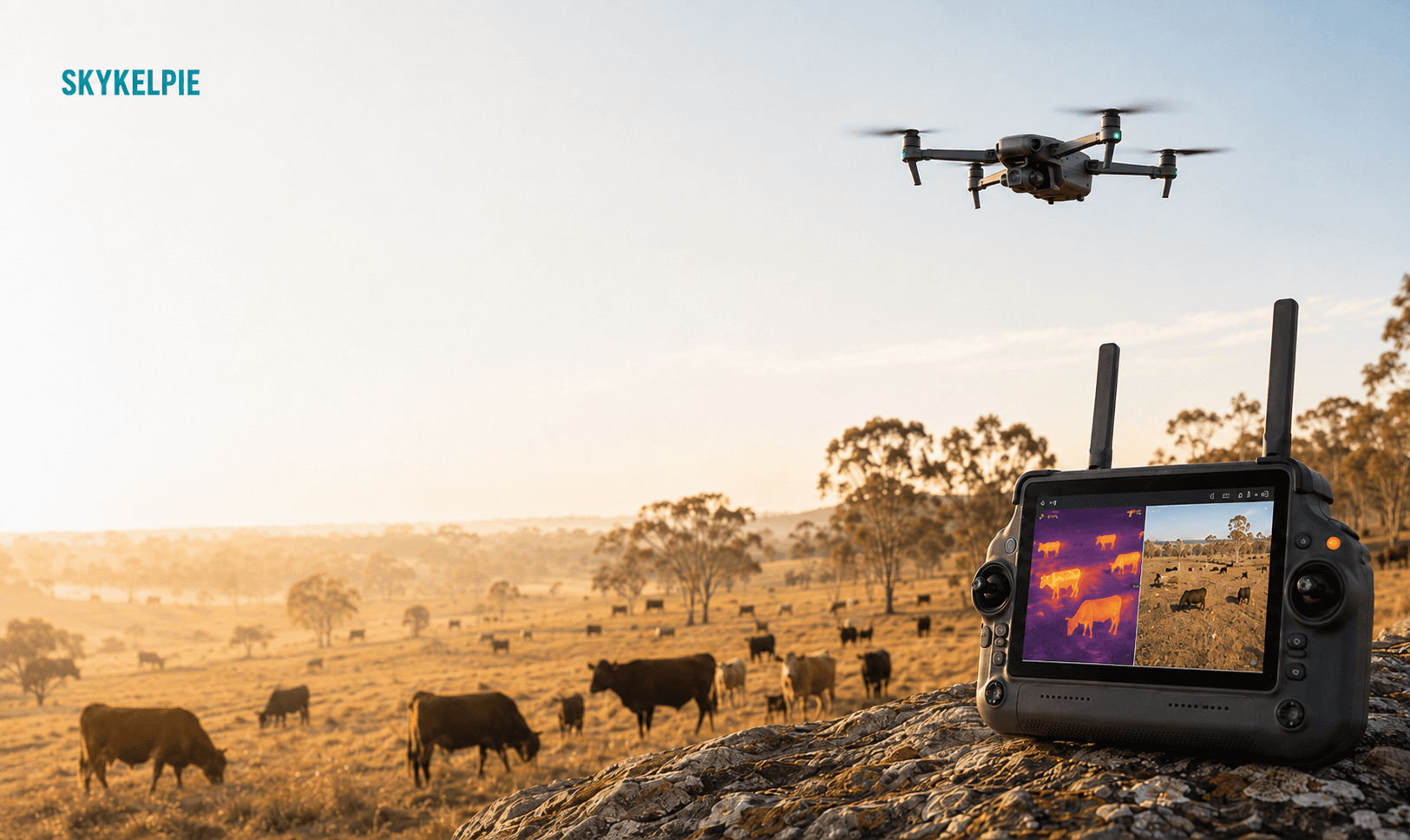
Most “best thermal drone” guides are written for hunters, security contractors or inspection crews. If you run cattle or sheep, much of that advice is irrelevant. You are not simply trying to detect a person at 300 metres. You are trying to find stock around timber at first light, distinguish a cow from a calf or a pig, move a mob without creating unnecessary pressure, and do it again tomorrow with equipment that lives in the ute.
This guide is about that job. It explains what thermal imaging can realistically show you on a property, which DJI systems we put in graziers’ hands and why, what the practical differences are, and when you may not need thermal at all.
What thermal sees on a property — and what it does not
A thermal camera detects long-wave infrared radiation from surfaces, producing an image related to apparent surface temperature rather than visible light. Livestock are easiest to detect when their thermal signature contrasts with the ground and vegetation around them.
Early morning, late afternoon and night often provide the strongest contrast. On a hot summer afternoon, sun-heated soil, trees and rocks can approach the apparent temperature of an animal, making the image flatter and detection less reliable. Winter may provide a longer useful daytime window, but weather, humidity, vegetation, viewing angle and recent solar heating still matter.
In practice, thermal is especially useful for:
Finding stock around timber and vegetation. Thermal can reveal exposed parts of an animal through gaps in vegetation or against a visually confusing background. It cannot see through solid branches, dense canopy or heavy grass, so detection still depends on line of sight and how much of the animal is exposed.
Working during the cooler parts of the day. Thermal is particularly useful around first and last light, when livestock are easier to work and visible-light cameras may struggle. Thermal-equipped drones have also been used in professionally authorised night operations on northern properties.
Counting livestock. Thermal can make manual headcounts faster when animals are separated against a cooler background. Tight mobs, overlapping animals, long grass and canopy can still cause missed or double counts, so uncertain detections should be checked with the RGB telephoto camera.
Finding feral animals. Pigs, wild dogs and other animals produce thermal signatures in the same way livestock do. Species identification still depends on size, shape, movement and, where possible, confirmation using the visible-light camera.
Important: thermal capability does not itself authorise night flying. Ordinary excluded-category operations are conducted during daylight. Flights after evening civil twilight or before morning civil twilight require the appropriate CASA-authorised operating framework.
Thermal will not read an ear tag, identify every animal through vegetation or remove uncertainty from a tightly packed mob. Ear-tag identification is the telephoto camera’s job and remains dependent on distance, tag size, angle, lighting and animal movement.
That is why the systems below combine thermal detection with visible-light zoom: find with thermal, then inspect and identify with RGB.
The three DJI thermal systems we recommend to graziers
DJI Matrice 4T — the portable all-rounder
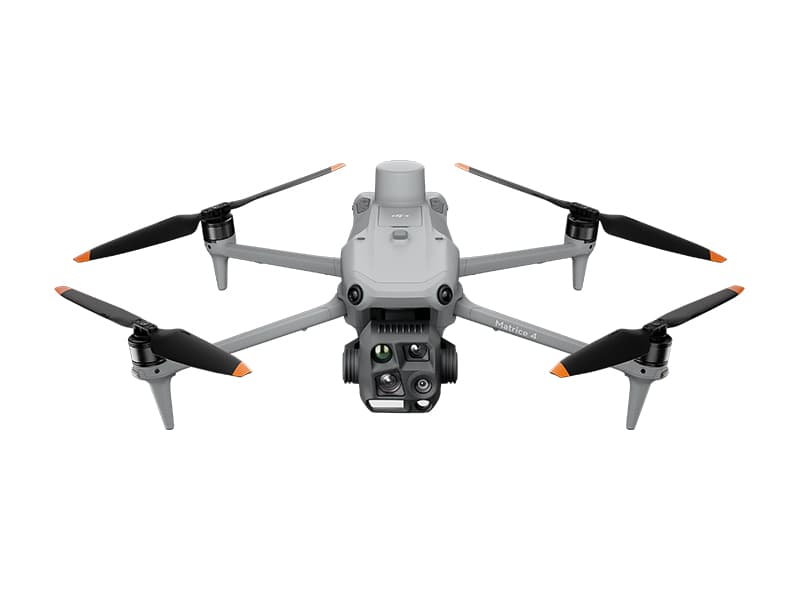
The DJI Matrice 4T is the thermal aircraft we most often recommend to owner-operators. It is a compact enterprise drone with a 640×512 radiometric thermal camera, wide and medium-tele cameras, a dedicated telephoto camera, laser rangefinder and near-infrared auxiliary light.
DJI specifies up to 112× hybrid zoom on the RGB camera system. That is not 112× optical zoom: it combines the telephoto camera’s approximately 7× view relative to the wide camera with digital magnification. The thermal camera separately offers up to 28× digital zoom.
DJI quotes a maximum flight time of 49 minutes with standard propellers, no payload, no wind and the battery flown to 0%. That is a laboratory maximum rather than a practical mission duration. With wind, accessories, manoeuvring and an appropriate return reserve, SkyKelpie generally plans around 35–40 minutes of useful field time.
The O4 Enterprise transmission system provides substantial link margin in open country, but the advertised transmission distance is not the legal operating distance. Unless separately authorised, CASA requires the pilot to maintain direct visual line of sight with the aircraft.
What makes the 4T particularly useful for livestock work is the combination of:
radiometric thermal detection;
a stronger RGB telephoto system for confirming uncertain detections;
the DJI AS1 speaker for repeatable directional audio cues;
a 1,219 g standard take-off weight that remains comfortably within the sub-2 kg category; and
a compact folding airframe that can be carried in the ute rather than deployed as a large aircraft system.
The SkyKelpie Matrice 4T Bundle packages the aircraft with the batteries, speaker, protection and training that we recommend for livestock work. Current inclusions and pricing are kept on the store page so this guide does not become outdated each time a bundle changes.
For a detailed breakdown of the cameras, accessories and operating features, see our Matrice 4 Series frequently asked questions.
DJI Matrice 4TD — when it lives outside
The DJI Matrice 4TD is the weather-resistant member of the family. It carries a multi-sensor payload comprising three RGB cameras, one 640×512 radiometric thermal camera, a laser rangefinder and an NIR auxiliary light.
The aircraft is IP55 rated, uses low-noise anti-ice propellers and has a quoted maximum flight time of 54 minutes under DJI’s controlled test conditions. It can be flown manually with the DJI RC Plus 2 Enterprise controller or integrated with DJI Dock 3 for remotely scheduled operations.
The 4TD makes sense when an aircraft will be stationed at a remote yard, bore or operational site and needs better resistance to dust, rain and temperature extremes. IP55 means weather-resistant, not waterproof or capable of flying safely in every weather condition.
Dock 3 can support remotely scheduled patrols, but owning a dock does not automatically authorise unattended or beyond-visual-line-of-sight flight. The operator still needs the procedures, personnel and CASA approvals appropriate to the intended operation.
The 4TD weighs approximately 1,850 g in its standard configuration and has a maximum take-off weight of 2,090 g. An AS1 speaker alone ordinarily keeps it below 2 kg, but some accessory combinations can push the actual operating weight above 2 kg. That matters because CASA’s applicable operating category depends on the aircraft’s gross weight for the flight.
For most owner-operators who intend to carry the aircraft in a vehicle and fly it personally, the folding 4T remains the simpler choice. The 4TD earns its additional cost when environmental protection, Dock 3 integration or its heavier-duty airframe provides a genuine operational benefit.
Zenmuse H30T — for a compatible large Matrice you already operate
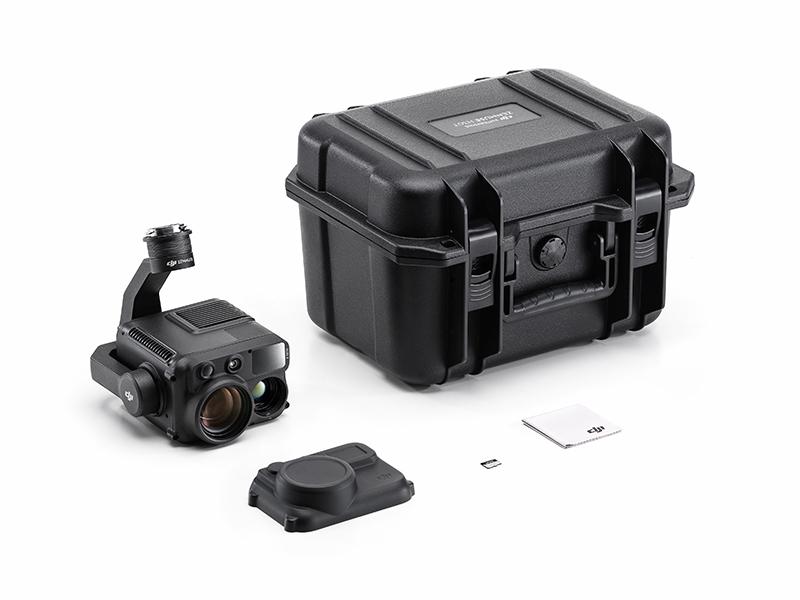
The Zenmuse H30T is a removable multi-sensor payload for compatible large DJI Matrice platforms, including the Matrice 350 RTK and Matrice 400. It is relevant to operators who already use one of these aircraft for inspection, surveying, mapping or other payload-based work and want to add a more capable thermal and long-range imaging system.
The H30T provides a native 1280×1024 radiometric thermal image, up to 34× optical RGB zoom and up to 400× digital zoom. That is a substantial imaging improvement over the integrated cameras on the Matrice 4T and 4TD.
Flight time, transmission performance, speaker compatibility and weather protection depend on the aircraft and payload configuration. A Matrice 400 with an H30T offers very different performance from an M350 carrying the same payload, so it is better to compare complete systems rather than the camera alone.
For a grazier starting from nothing, an H30T and large Matrice airframe will rarely be the first purchase. It costs considerably more, requires more equipment to transport and deploy, and places the operation in the over-2 kg category. It becomes compelling when the property or organisation already has the airframe, trained personnel and a broader need for high-resolution thermal imaging.
A quick comparison
Feature | Matrice 4T | Matrice 4TD | H30T on M350/M400 |
|---|---|---|---|
Best suited to | Portable owner-operator use | Weather-resistant manual or Dock 3 operations | Operators already using a compatible large Matrice |
Thermal imaging | 640×512 radiometric; 1280×1024 super-resolution output | 640×512 radiometric; 1280×1024 enhanced output | Native 1280×1024 radiometric |
RGB zoom | Up to 112× hybrid | Up to 112× hybrid | Up to 34× optical and 400× digital |
Aircraft weather rating | No published aircraft IP rating | IP55 | Airframe-dependent; H30T payload is IP54 |
Quoted maximum flight time | 49 minutes without payload | 54 minutes | Airframe and payload dependent |
Speaker | DJI AS1 | DJI AS1 | Airframe-dependent |
Standard aircraft weight | 1,219 g | 1,850 g | More than 2 kg |
CASA category | Sub-2 kg excluded category | Sub-2 kg only while actual gross weight remains at or below 2 kg | Small RPA, more than 2 kg but not more than 25 kg |
Key qualification | Portable and straightforward, but still subject to registration, accreditation and standard operating conditions | Accessories may take it over 2 kg; Dock, night and BVLOS operations may require further approvals | Landholder exclusion may apply on owned or leased land; other operations generally require the appropriate RePL and ReOC framework |
Full specifications, current pricing and the Matrice 4 models side by side are available on our thermal drones for livestock and farms page.
The part the specification sheets skip: the speaker
Drone mustering relies principally on aircraft position, pressure and the animals’ response to sound. Some livestock respond adequately to rotor noise alone. A speaker adds a louder, more repeatable directional cue and gives the operator greater control over what the mob hears.
The DJI AS1 speaker on the Matrice 4T and 4TD supports live voice, recorded audio, imported sound files and English text-to-speech. It can be used to play a familiar livestock call, a recorded dog bark or another cue suited to the animals and operating method.
For properties intending to move livestock rather than simply locate or inspect them, speaker compatibility is an important comparison point. It is not a substitute for low-stress stockmanship. Volume, distance, cue selection and aircraft movement all need to be adjusted to the mob’s response, particularly while animals are learning to work with the drone.
Our practical guide explains how to install and use the DJI AS1 speaker on the Matrice 4 Series.
Do you need a licence?
The short answer is that a Matrice 4T can ordinarily be flown for farm and business purposes without a Remote Pilot Licence (RePL) or Remotely Piloted Aircraft Operator’s Certificate (ReOC), but “no licence” does not mean “no CASA requirements.”
The Matrice 4T has a standard take-off weight of 1,219 g and a maximum take-off weight of 1,420 g. It therefore remains within CASA’s sub-2 kg excluded category, including when fitted with its approved accessories.
A person operating it for business or as part of their work still needs to:
obtain an Aviation Reference Number;
hold current RPA operator accreditation;
register the aircraft with CASA; and
comply with the standard operating conditions and applicable airspace rules.
Those operating conditions include maintaining direct visual line of sight, ordinarily remaining at or below 120 metres above ground level, keeping the required distance from people, avoiding prohibited operations and flying only one aircraft per pilot at a time.
Unlike the over-2 kg landholder exclusion, the sub-2 kg category is not limited to the operator’s own property and does not automatically prevent paid work. A Matrice 4T can therefore be used for commercial services without a RePL or ReOC when the operation remains eligible for the sub-2 kg excluded category and complies with all its conditions.
Aircraft weighing more than 2 kg but not more than 25 kg may qualify for CASA’s landholder excluded category when:
the RPA is operated over land owned or leased by the RPA owner;
the pilot is the RPA owner or is operating it on the owner’s behalf;
the flight is for an eligible activity such as aerial spotting or an agricultural operation;
no direct reward or compensation is received for the operation; and
the remaining landholder and standard operating requirements are met.
This distinction becomes relevant to a 4TD when accessories take its operating weight above 2 kg, and to any H30T system carried by an M350 or M400.
Read our plain-English guides to drone licensing for livestock mustering, CASA’s landholder rule and operating a drone over 2 kg in the excluded category.
Night, EVLOS and BVLOS operations: excluded-category privileges do not authorise night or beyond-visual-line-of-sight flight. These operations require the appropriate licensed and certified operating framework, procedures and CASA authorisations. A RePL by itself is not permission to conduct every type of advanced operation.
When you do not need thermal
If you muster in daylight on open country and the main problem is distance, labour and time rather than finding hidden animals, you may not need to pay for a thermal camera.
A daylight camera drone fitted with a compatible speaker can perform much of the movement and inspection work at a considerably lower purchase price. Thermal earns its cost when livestock are difficult to locate around timber, scrub or long grass; when you regularly search at the edges of daylight; when feral-animal detection matters; or when you need to distinguish warm animals from a visually confusing background.
Our best drone for mustering guide compares daylight, thermal and speaker-equipped options by property, livestock and budget.
What it costs and how people buy
Most SkyKelpie Matrice 4T customers do not simply click “add to cart.” They speak with us about the property, livestock, vegetation, intended operating times, required batteries, charging arrangements and whether the aircraft will be used only for observation or for active mustering.
We then build the configuration around the job rather than adding accessories for the sake of a longer parts list.
If that is how you prefer to buy, request a tailored quote. If you already know the 4T is the right system, the current Matrice 4T bundle is available in the store.
Proof from real properties
At Stanbroke’s Fort Constantine property, SkyKelpie conducted a practical trial involving approximately 500 Brahman heifers in a 973-hectare paddock. The cattle were successfully directed to the intended destination, and Stanbroke subsequently adopted Matrice 30T and Matrice 4T systems across two North West Queensland properties.
More broadly, SkyKelpie-supported customers collectively manage more than 100,000 head of livestock across Australian operations. That does not mean SkyKelpie has personally mustered every one of those animals; it means the technology is being used within commercial livestock enterprises operating at that scale.
You can read more about the 100,000-head customer milestone.
That is the evidence we use when recommending an aircraft: what has worked with real stock, on real country, supported by appropriate training and operating procedures—not simply which model has the longest specification sheet.
Sources
Featured in this guide

Was this article helpful?
Your feedback helps us improve our documentation